Bala Ganita 1 - Foundation
Where Mathematical Thinking Begins
Bala Ganita Level 1 introduces children to mathematics through observation, comparison, classification, patterns, shapes, counting and meaningful activities—building the foundations for strong number sense and mathematical thinking.
OBSERVE • COMPARE • DISCOVER • REPRESENT

THE BEGINNING
Mathematics Before Procedures
Before children can confidently work with mathematical operations, they need to develop the ability to observe, compare, classify, recognise patterns, understand quantities and see relationships. Bala Ganita Level 1 provides these foundational experiences through carefully designed activities. Children learn by looking, doing, comparing, representing and thinking rather than simply memorising mathematical facts. Strong mathematics begins with strong foundations.

LEVEL 1 LEARNING AREAS
Building the Foundations Step by Step
Observation & Visual Reasoning
Notice details, differences, similarities and relationships.
Matching & Classification
Match related objects and organise them according to shared characteristics.
Comparison
Explore bigger/smaller, taller/shorter, longer/shorter, thicker/thinner and other relationships.
Patterns
Recognise, continue and create simple patterns.
Shapes
Identify and explore shapes and their characteristics.
Counting
Develop meaningful counting through one-to-one correspondence.
Early Number Sense
Understand numbers as quantities and relationships.
Representation
Express mathematical ideas using objects, marks, pictures and simple symbols.
PROBLEM-BASED LEARNING
Children Learn by Solving
Every activity gives the child something to observe, compare, organise, count, complete, represent or solve. The teacher guides the child's thinking without immediately providing the answer. LOOK → THINK → TRY → DISCOVER → EXPLAIN
Sample Problems
Problem 1
Click Here
Click Here
Click Here
Click Here
Click Here
Click Here
Click Here
Click Here
Click Here
BEYOND COUNTING
Developing the First Habits of Mathematical Thinking

THE ROLE OF THE BALA GANITA TEACHER
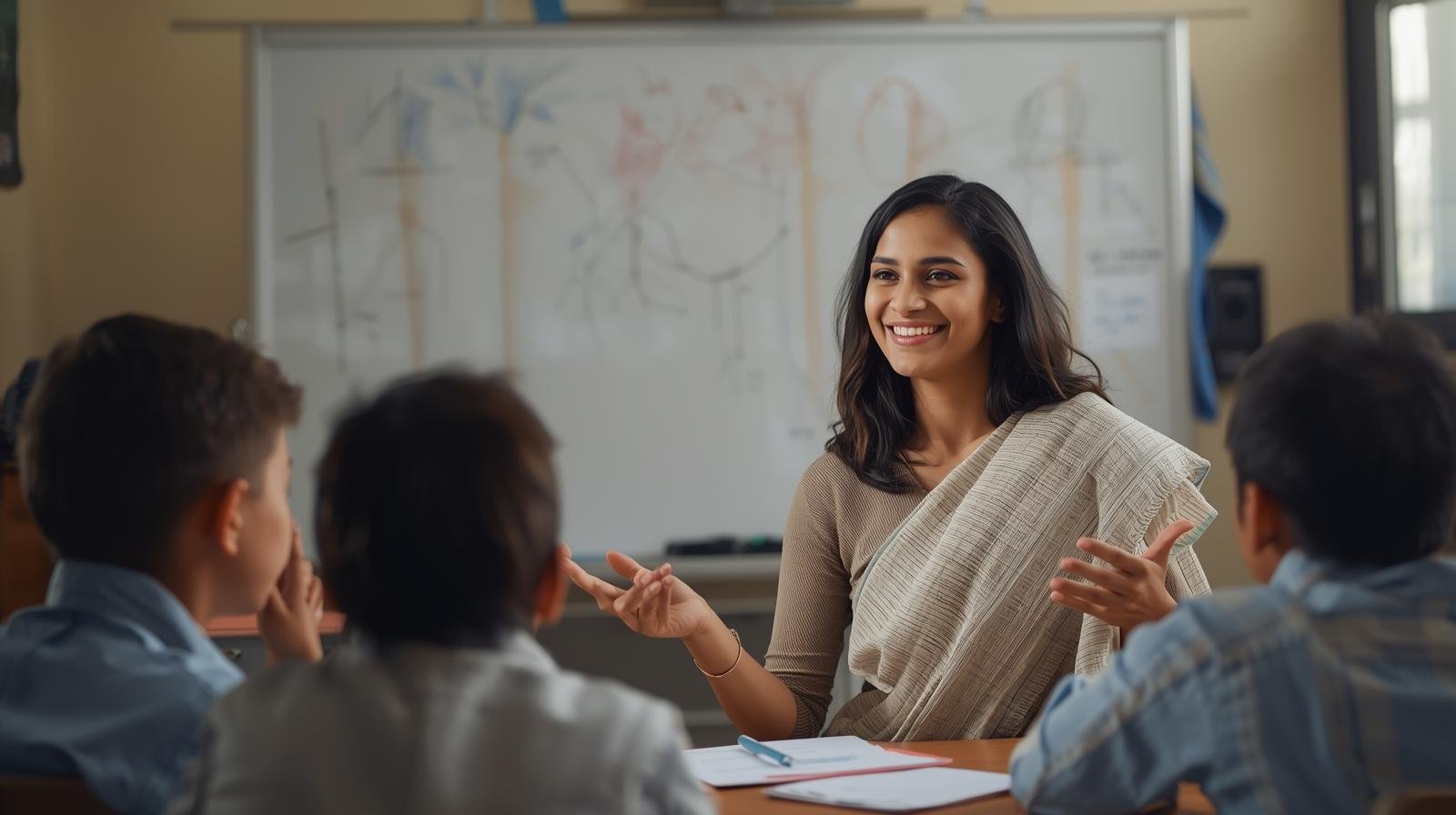
The Teacher Guides Thinking
In Bala Ganita, the teacher does more than demonstrate procedures. The teacher observes how the child approaches an activity, asks appropriate questions and encourages the child to explain what they notice, what they tried and how they reached an answer.

PROGRESS YOU CAN SEE
By the End of Level 1
Children should have strengthened their ability to:
- Observe and identify mathematical characteristics.
- Match and classify objects.
- Compare size, length, height, quantity and other properties.
- Recognise and continue patterns.
- Identify and work with basic shapes.
- Count objects using one-to-one correspondence.
- Connect quantities with early number representations.
- Represent simple mathematical information.
- Approach unfamiliar activities with greater confidence.
- Begin explaining their mathematical thinking.